PWA or Native App: The Short Answer
Progressive web apps and native app development are two of the most important approaches for building mobile experiences in 2026. Businesses, startups, and enterprises are all trying to decide which path offers the best balance of performance, cost, user experience, and long-term scalability. The answer is not always the same for every project, because both options have evolved significantly over the last few years. Understanding where each one shines can help you make a smarter product decision.
What Are Progressive Web Apps?
Progressive web apps, often called PWAs, are web applications that behave much like mobile apps while running through a browser. They are built with standard web technologies such as HTML, CSS, and JavaScript, but they can provide app-like functionality such as offline access, push notifications, home screen installation, and fast loading.
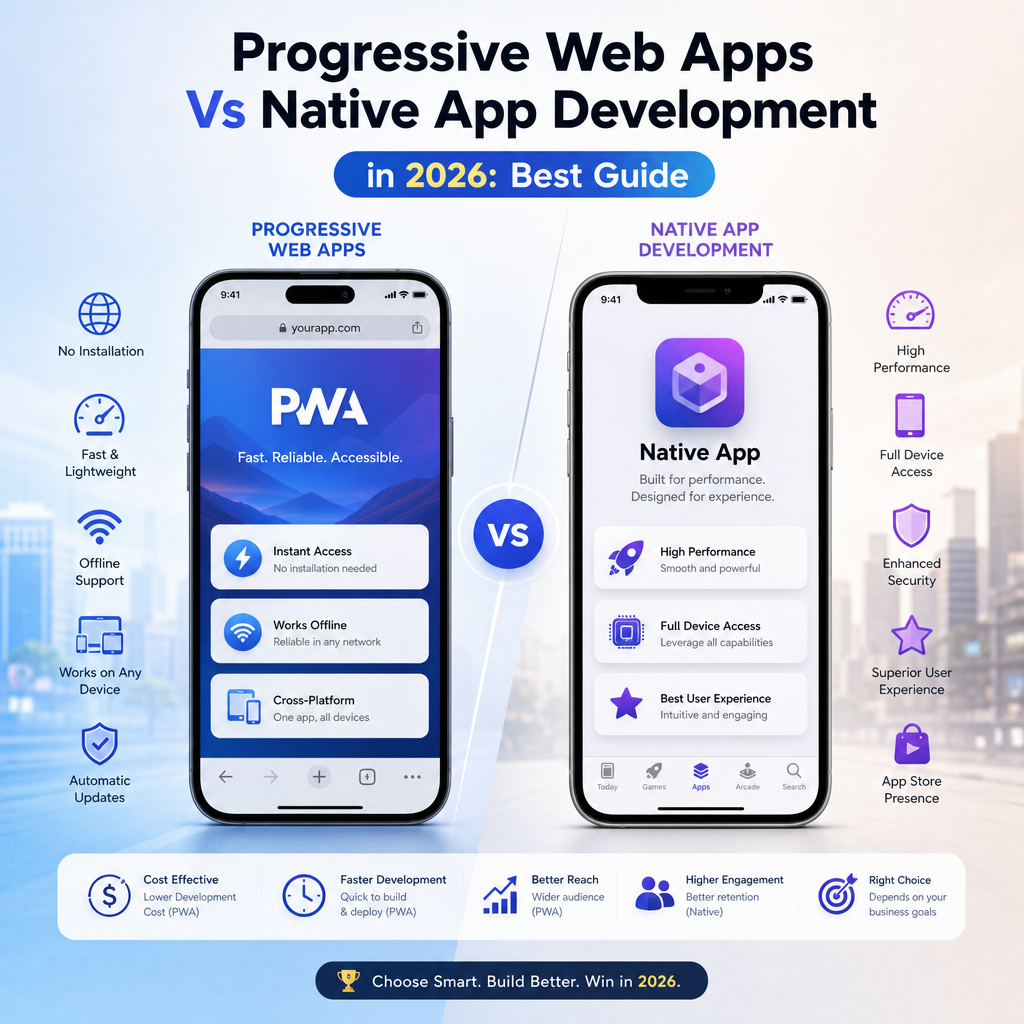
A PWA is designed to feel responsive, reliable, and engaging. Users can open it in a browser, save it to their device, and use it with minimal friction. Since PWAs do not require a traditional app store download, they reduce the number of steps between discovery and usage.
In 2026, PWAs continue to be attractive because they allow businesses to reach users across devices with a single codebase. They are especially useful for ecommerce, content platforms, service businesses, and companies that need quick deployment without building separate mobile apps from scratch.
What Is Native App Development?
Native app development refers to building mobile applications specifically for a platform such as iOS or Android. These apps are written using platform-specific languages and tools, like Swift or Objective-C for iOS and Kotlin or Java for Android.
Native apps are installed directly onto a device and can take full advantage of the operating system’s capabilities. This includes access to advanced camera features, GPS, Bluetooth, biometric authentication, background processing, and the latest hardware integrations. Because they are optimized for a specific platform, native apps often deliver the best possible performance and user experience.
For businesses that need powerful device features, complex animations, or highly polished interactions, native app development remains a strong choice in 2026.
Progressive Web Apps vs Native App Development: Core Differences
The biggest difference between progressive web apps and native app development is how they are delivered and how deeply they integrate with the device.
PWAs run in a browser and can be installed like apps, but they still rely on web technology. Native apps are built specifically for the device operating system and installed through app stores.
- Development process: PWAs usually require one codebase, while native apps often require separate development for iOS and Android.
- Installation: PWAs can be accessed instantly in a browser, while native apps typically require app store downloads.
- Performance: Native apps generally offer stronger performance for demanding tasks and graphics-heavy features.
- Device access: Native development provides deeper access to sensors, hardware, and system features.
- Maintenance: PWAs can be easier to update because changes are deployed on the web.
- Distribution: Native apps benefit from app store visibility and trust, while PWAs rely more on web discovery and direct traffic.
These distinctions matter because they affect cost, speed to market, user acquisition, and long-term flexibility.
Why Progressive Web Apps Matter in 2026
Progressive web apps have become a practical choice for many businesses because they shorten development cycles and reduce friction for users. In 2026, web capabilities have improved enough that many user journeys can be handled effectively through a PWA. Some of the biggest advantages include:
Lower development and maintenance costs
A single PWA can serve multiple platforms, which reduces engineering overhead. Instead of managing separate native teams for iOS and Android, companies can focus on one core product.
Faster time to market
PWAs can be launched more quickly than fully native solutions. This makes them useful for startups, MVPs, and businesses that want to test an idea before investing in larger mobile development efforts.
Easy updates
Because PWAs are web-based, updates can be rolled out immediately. Users get the latest version without waiting for app store approvals or manual downloads.
Strong reach and accessibility
A PWA can be accessed through a URL, which makes sharing and discovery easier. This is valuable for companies that want to capture users without forcing an install.
Better for content and commerce
Many online stores, booking platforms, and media services use PWAs because they provide a smooth, fast experience with less complexity than native apps.
Why Native App Development Still Leads in Some Areas
Even with the growth of PWAs, native app development remains the best option for many use cases. If your product depends heavily on mobile-first features or advanced interactions, native still has a clear edge.
Superior performance
Native apps are built for one operating system, which allows for optimized performance. This is especially important for gaming, real-time communication, AR features, and resource-intensive applications.
Deeper hardware integration
Native apps can access device features more reliably and fully. This includes advanced biometric security, background syncing, device sensors, and platform-specific APIs.
Best user experience for mobile-first products
For apps where speed, animation quality, and polished interface details matter, native development provides the highest level of control.
App store presence
Being in the Apple App Store or Google Play Store can improve credibility and help with discovery. For some brands, app store distribution is an important part of the growth strategy.
Better support for complex mobile products
If your application has advanced offline workflows, custom gestures, heavy media processing, or strict security requirements, native development is often the safer and more powerful choice.
Choosing Between Progressive Web Apps and Native App Development
The best decision depends on your business goals, target audience, and technical requirements. In 2026, there is no universal winner.
Choose a PWA if…
- You need a fast and cost-effective launch
- Your product is content-driven or ecommerce-focused
- You want a single codebase across platforms
- You expect users to discover the product on the web first
- Your app does not require heavy access to native device features
Choose native if…
- Your product depends on advanced device capabilities
- Performance is a top priority
- You are building a highly interactive or graphics-heavy app
- You need the full app store experience
- Your long-term strategy depends on a premium mobile user experience
In many cases, the right answer is not either-or. Some businesses use PWAs for web acquisition and native apps for power users. Others build a PWA first, then invest in native apps once product-market fit is clear.
How 2026 Trends Affect the Decision
Several trends in 2026 are shaping the way companies evaluate progressive web apps and native app development.
AI-assisted development
AI tools are making both web and native development faster. Teams can prototype more quickly, automate repetitive coding tasks, and improve testing workflows. This reduces the cost difference between the two approaches, but native projects can still become more complex as they scale.
Cross-platform expectations
Users now expect consistent experiences across desktop, tablet, and mobile. PWAs align naturally with this expectation because they run across devices through the browser.
Mobile-first competition
At the same time, many consumer products still rely on highly polished mobile interactions to stand out. Native apps remain critical for brands that compete on experience quality.
Improved browser capabilities
Browsers have become more powerful, which continues to strengthen the case for PWAs. Features that were once limited to native apps are increasingly available on the web, although not always with the same depth or reliability across all platforms.
Best Practices for Making the Right Choice
Before choosing between progressive web apps and native app development, ask these questions:
- What is the most important business goal: speed, cost, performance, or retention?
- Do users need app store installation, or is browser access enough?
- Will the app rely on advanced device features?
- How often will the product need updates?
- Is the first version an MVP or a long-term flagship product?
- Do you need one codebase or can you support multiple platform builds?
Answering these questions early can prevent expensive rework later.
It is also wise to think beyond launch. A cheap solution that cannot scale can become more expensive over time, while an advanced native product may be unnecessary for a simple service app. The best choice is the one that aligns with your actual product needs, not just current trends.
The smartest strategy is to evaluate your business model, technical requirements, and growth plans before deciding. For many companies, a PWA offers the fastest path to market. For others, native development is worth the higher investment because it unlocks capabilities that web apps still cannot fully match.
In the end, the best guide is not about choosing the most popular approach. It is about choosing the right one for your users, your product, and your long-term success.
Final Verdict
Progressive web apps and native app development both have strong roles in 2026. PWAs are ideal for fast, accessible, and cost-efficient experiences that work across devices with less complexity. Native app development remains the best option for performance, deep device integration, and premium mobile experiences.